Brazilian free-tailed bat
|
Common name: Brazilian free-tailed bat
Scientific name: Tadarida brasiliensis Family: Molossidae |
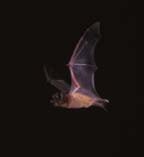
Photo by Jerry L. Gingerich, D.V.M.
|
Description: The short fur varies in color from dark brown to grayish-brown. Like other bats in the family Molossidae the tail extends well beyond a short tail membrane. The upper lips have vertical wrinkles. Long stiff hairs protrude from the toes and extend beyond the claws. The Brazilian free-tailed bat has a scent gland that emits a musky odor. A colony of these bats can be recognized from a distance by the odor alone. The odor is often mistakenly thought to come from the bat guano.
Wingspan: 11-13 inches
Body length: 2.2-2.9 inches
Weight: 0.4-0.5 ounces
Florida roosting preferences: Colonial. This species forms large colonies ranging from a few hundred to several thousand. It roosts almost totally in man-made structures, primarily, buildings and bridges. It particularly likes to roost under barrel tile roofs. This is the most likely species to move into bat houses in Florida.
Food preferences: Insectivorous. Feeds on moths, flies and beetles.
Reproduction: Females give birth to a single pup, in early June.
Florida status: Common. This is likely Florida's most abundant bat.
Florida range: The Brazilian free-tailed bat is found throughout Florida, except the Florida Keys.
Note: This species is commonly referred to as the Mexican free-tailed bat in the western United States.
Copyright Florida Bat Center 2005
Wingspan: 11-13 inches
Body length: 2.2-2.9 inches
Weight: 0.4-0.5 ounces
Florida roosting preferences: Colonial. This species forms large colonies ranging from a few hundred to several thousand. It roosts almost totally in man-made structures, primarily, buildings and bridges. It particularly likes to roost under barrel tile roofs. This is the most likely species to move into bat houses in Florida.
Food preferences: Insectivorous. Feeds on moths, flies and beetles.
Reproduction: Females give birth to a single pup, in early June.
Florida status: Common. This is likely Florida's most abundant bat.
Florida range: The Brazilian free-tailed bat is found throughout Florida, except the Florida Keys.
Note: This species is commonly referred to as the Mexican free-tailed bat in the western United States.
Copyright Florida Bat Center 2005